Posted in Monday Mayhem

The Three Commandments

In recent times, moviegoers have come to realize there are no absolutes when dealing with the horror genre. Ghosts can eat food (Pirates of the Caribbean), werewolves can change at will (Underworld), and vampires can sparkle when exposed to sunlight (Twilight). However, all bets are off when we talk about zombies. Zombies live in a world of absolutes.

Zombie Hand
Zombie Hand

As a primer to my Monday Mayhem series, let’s examine The Three Commandments of the undead. Established by director George A. Romero in the 1968 movie Night of the Living Dead and solidified in his 1978 film Dawn of the Dead, these three laws are what make the zombie genre unique. Without them, zombies wouldn’t exist in their present form.

I—The Dead Have Come Back to Life

A zombie isn’t a zombie unless it comes back from the dead. Much like vampires, zombies were once dead. Hence the name: undead. Through a biochemical change, voodoo or some other form of reanimation, the dead rises. This is the crux of zombiehood. Without it, zombies simply are not zombies.

What about a virus? In modern storytelling, a virus is the usual suspect in the blame-game for many undead creations. Typically, the virus runs through a population, changing them to become zombies. In strict technical terms, these creatures may not qualify as true zombies if the victims do not initially die. However, I argue if a virus has an element of death associate with it (biological or intellectual), then of course the resultant creature is none other than a zombie.

The key here is to note a physical transformation from death to life.

II—The Undead Crave Human Flesh

Every biological species requires sustenance to maintain health. Zombies do not. Zombies eat because it’s in their nature to hunger after human meat. It’s a compulsion. They cannot turn off the desire to slay a human and feed off the body. They just can’t. They are like the sharks of the underworld. They yearn, hunt, kill and eat. That’s it. They don’t stop. From one body to another, they’ll consume a whole town without regard. They are never satiated.
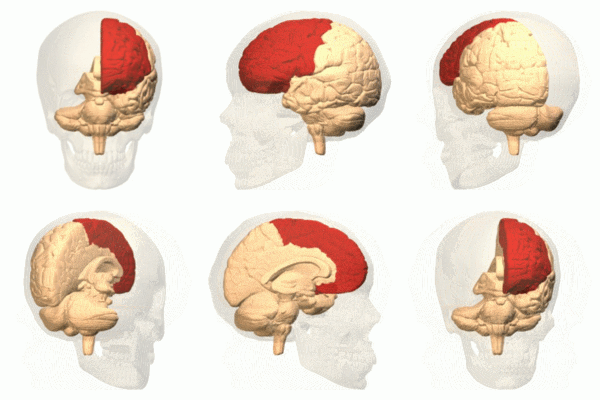
The Frontal Lobe
The Frontal Lobe

III—The Undead Will Die with a Blow to the Brain

The only thing that will stop a zombie is the destruction of its brain. A hunter of the undead can use various methods to attain this result. The most common is a bullet to the head. A knife through the temple will also do a fine job of ridding the earth of the vermin species. As would any of these other methods: An ice pick through the eye socket, multiple blows from a baseball bat, a sharp stick through its mouth thereby severing its spinal cord, a screwdriver to the back of the skull, a meat cleaver aimed directly at the frontal lobe, etc. The possibilities are endless. The purpose is to render the creature dead by inflicting the maximum amount of trauma to its brain. Once complete, the zombie will no longer pose a threat to any other humans.

Have you ever heard of The Three Commandments? What are your thoughts about zombiehood?

Posted in Monday Mayhem

Death’s Cure

Back in June last year, the Centers for Disease Control and Prevention (CDC) issued a statement denying knowledge of any virus that may reanimate dead tissue. O-kay. Further, they denied knowledge of any virus that would cause zombie-like symptoms. Right. This is my Monday Mayhem post and—I’m sorry, I have to keep from laughing. Give me a second. Ahem…

Nurse
Nurse

In an email to Huffington Post, David Daigle, the American health agency representative wrote: “CDC does not know of a virus or condition that would reanimate the dead (or one that would present zombie-like symptoms).”

Did you catch that? They’re saying they don’t know of a virus or condition that could reanimate dead tissue. They didn’t say it wasn’t possible. Seriously, what goes on behind those doors of the CDC?

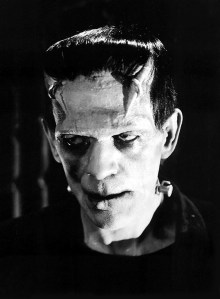
You know, another fellow also believed in the reanimation of the dead. He was an obsessed scientist with the idea he could create life. He had an assistant who would provide him with the raw materials. He’d harvest the dead parts, sew them together and call the result human. But nothing could be further from the truth.

I’m talking of course of Dr. Victor Frankenstein and his inept assistant Igor. His ideas were commendable. Take the dead and breathe life back into them. Nothing short of a miracle, really. The results, however, told of a different story. A story of a scientist gone mad who wanted more than anything than to play God. His creature became one of the first known zombies in classical literature.

Frankenstein
Frankenstein

What makes Frankenstein’s story unique, or rather the lesson we can learn from the monster tale is “no good deed goes unpunished.” (I put it in quotes because it’s a famous saying. Didn’t know what else to do with it). In his zeal to create life out of nothingness, the good doctor didn’t stop to ask if he should. Thus, he created a walking corpse with barely enough intelligence to scour a frying pan.

The most horrific events to have happen to humanity have always been because of good intentions.

Getting back to what the CDC didn’t say. They didn’t say dead tissue reanimation isn’t possible. This leads one to conclude, albeit speculation based on evidentiary inference, that the CDC is studying dead matter reanimation. Yeah, this is the stuff that keeps me up at night.

What if it were true? What if we had the power to eradicate death? Then what?

Imagine a world where no one died. There would be no need for life insurance. Funeral homes would go out of business. All that cemetery land could go to house the living instead. We’d have more money for the economy, since mandatory retirement would disappear. We’d have less social programs. Terminal illnesses would be a thing of the past. And there would be no need for half-price Tuesdays for seniors.

Ah, can you hear the wheels of good intention churn?

If no one dies, how are we to feed everyone? When the cemetery land vanishes, where is everyone going to live? Will there be enough jobs to go around? And the big question: If we eliminate death does this mean we can eliminate aging? Because if we haven’t eliminated aging—we’ve got a major problem.

After about a hundred years, guaranteed we’ll have a real zombie apocalypse on our hands.

Comedic genius George Carlin once said:

“You know what I think they ought to do with those Miss America contests? I think they ought to keep making the losers come back until they win. I’ll tell you, that would get a little spooky after about thirty five years or so, huh?”

What do you think? Are we on the road to creating a Frankenstein monster? Should the CDC open its research facilities to third party monitoring?

Posted in Women Who Wow Wednesday

Alice

The Hive. A secret research facility buried deep within the bowels of the earth. Red Queen. A supercomputer designed to maintain environmental control over The Hive. Alice. A wandering amnesiac. This is Women Who Wow Wednesday.

Resident Evil's Alice
Resident Evil’s Alice

There’s only one other badass chick who could even come close to Alice, and that’s Beatrix Kiddo of Quentin Tarantino‘s Kill Bill movies. Wait a minute. Correction. Hit-Girl definitely is in the same league as Alice, zombie killer extraordinaire.

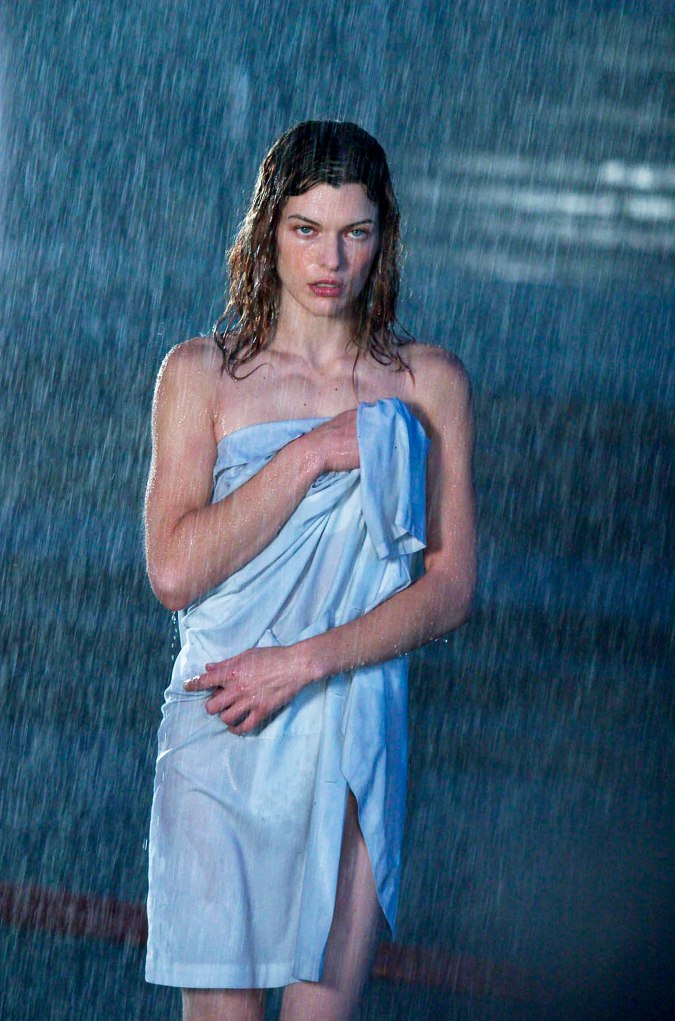
She once played Leeloo in the 1997 movie The Fifth Element. However when Milla Jovovich took on the role of Alice in the Resident Evil franchise, she guaranteed her place in film history as the go-to character for zombie eradication.

Originally connected to director/producer George A. Romero (Night of the Living Dead, and Dawn of the Dead), Resident Evil blew away the box office in March 2002 taking in $102 Million worldwide. Not bad for a $33 Million budget. Based on the 1996 video game, the film spawned four sequels, a CG movie, countless other video games, and a novelization called Resident Evil: The Umbrella Conspiracy.

Besides dancers hired to play zombies and dogs that couldn’t keep their makeup on (they kept eating their blood and meat costumes), what’s the big deal with Resident Evil?

Milla Jovovich as Alice

Alice.

The audience is never quite sure what to make of her. She can pound a zombie to a mush of goo but also can slink across a floor in her most vulnerable, naked state. Proficient in firearms and hand-to-hand combat, Alice’s greatest strength is not her physical skill sets, though she may take on a hoard of undead single handedly, but her penchant for keeping her team safe. The very team sent to destroy Red Queen, The Hive’s supercomputer.

As the film and the series progresses, it becomes obvious Alice is not like other females. She possesses a degree of cunning that always matches her sad countenance. Her eyes give away her heart’s loneliness, even in the course of arms flaying, bullets flying, knives wounding, and heads rolling. She is superhuman. Why? How did it happen? What made her that way? Who gave her that power?

The key with Alice is the welfare of others. No matter how bad things get, zombies could crash through a door, smash through a window, tear apart walls and attack from all sides, Alice focuses on one thing and one thing only—how can she help the others. Nothing else distracts this vicious vixen of voracious vindication.

Others first. Her last.

There’s almost an element of religion with Alice. It’s as if she knows the golden rule: Do unto others as you would have others do unto you.

Have you seen Resident Evil? What do you think of Alice? Although not called zombies in the film, what do you think of the creatures?

Posted in Monday Mayhem

Classic Literature Zombie Style

Yesterday morning I read an article that stated Seth Grahame-Smith’s Pride and Prejudice and Zombies might head to theaters soon. You read that right. Pride and Prejudice and Zombies. I wonder how the playful Elizabeth Bennet will choose among her suitors this time. Guaranteed Mr. Right would need martial arts training.

Word Jumble
Word Jumble

For this edition of Monday Mayhem, I’d like to explore other classics that would benefit from a zombie facelift.

Okay. Ready? Set. Here’s my take on classic literature zombie style:

Romeo and Juliet and Zombies—Juliet outside on the balcony: “Oh, Romeo, Romeo, wherefore art the undead that we shall henceforth quicken their demise? Deny me not, be but sworn the pleasure to raise my knife against the bowels of the fiends.”

Anne of Green Gables and Zombies—Anne walking through Violet Vale with Diana: “There’s such a lot of different Annes in me, I frighten myself sometimes. I have horrid dreams of violence. Is it wrong to want to thrust a fireplace poker into the head of a walker?”

Les Misérables and Zombies—Victor Hugo: “He never went out without a skull under his arm, and he often came back with two.”

Hamlet and Zombies—Hamlet holding a skull: “Alas, poor Yorick! I knew him whole; before the eaters raised their gnashing teeth and their unbridled hunger to tear at his flesh, discarding his limbs as puppetry. For whence forth are thy gibes now among thy pieces?”

Great Expectations and Zombies—Miss Havisham: “Kill it, kill it, kill it! If it resists, kill it. If it wounds you, kill it. If it tears your heart to pieces—and as it gets older and stronger, it will tear deeper—kill it, kill it, kill it!”

The Three Musketeers and Zombies—Aramis to D’Artagnan: “Athos takes his creature beheadings very seriously. Not to worry, he’ll be his usual charming self by morning.”

Alice in Wonderland
Alice in Wonderland

Alice’s Adventures in Wonderland and Zombies—The opening line: “What is the use of a book, without the pleasure of jamming it down the throat of a brain chewer?”

The Adventures of Sherlock Holmes and Zombies—Holmes holding a bow: “It’s elementary, my dear Watson. Once the creatures cross the threshold, these razor sharp arrows will dispatch them whole. There will be nothing left of the boastful relics.”

A Christmas Carol and Zombies—Ghost of Christmas Present to Ebenezer Scrooge: “There is nothing in the world so irresistibly contagious as destroying a maggot bag with your bare hands.”

Julius Caesar and Zombies—Antony’s oratorio: “Friends, Romans, countrymen, protect thy ears. The harbingers have devoured Caesar to the bone. Lift up thy swords and swear vengeance to the beasts, spilling their entrails forthwith beyond the square.”

Can you think of other classics more deserving of a zombie makeover?

Posted in Monday Mayhem

How Far Would You Go?

How far would you go if it meant preventing the death of a loved one? Would you go beyond everything taught as wrong in order to save your family? Would you do wrong? In an attempt to answer these questions, this edition of Monday Mayhem explores humanity’s moral weakness during an apocalyptic event.

Biohazard
Biohazard

When things go well, humans tend to enjoy the spoils of their labor in relative peace and security thinking no one or anything could possibly disrupt their harmony. But throw in a crisis of biological proportions and the average person runs into the streets terrified their life as they know it is over.

The first thing to happen during a disaster of this kind is a run up on cash. Folks try to get as much of it as they can. But the old adage “cash is king” will not work when humanity is on the cusp of a new paradigm. It will all be about bartering and sharing. Even if folks head to the grocery store in an attempt to outwit their neighbor hoarding the last bit of the foodstuffs, they will have to do more than search, beg, and borrow. Guaranteed the neighbors have weapons. Guaranteed they wouldn’t be afraid to use them.

The question is, how far would you go?

Once society breaks down and the last morsels of food disappear, it will be up to the survivors to make due with what remains. And if the biological catastrophe involves a change in a large percentage of the population’s eating habits, there will be far more to fear than starvation. A new enemy will have emerged to either unite the survivors or tear them apart. An enemy so brutal and carnal, the survivors would have to do anything and everything to avoid them in order to remain alive.

Again, how far would you go?

Johann Sebastian Bach

A simple bath in clean water may take weeks. A warm bed with covers and sheets may take months. The joy of listening to any of Bach’s Brandenburg Concertos or any music for that matter may never happen again. The simplicities in life, the things we take for granted, a quick walk through the woods, a chat on the phone, an email, reading a letter, a caress, taking a bus, riding on a train, walking a dog, smelling a flower, sitting on the veranda watching the rain fall, a hug, the taste of vanilla, a dance, a play, a movie, the joy of writing, talking, humming, a kiss—may disappear forever.

How far would you go?

Posted in Women Who Wow Wednesday

Ana

One morning Ana wakes up noticing a little girl at the bedroom door. Her nightgown covered in blood. The attack begins. My Women Who Wow Wednesday series continues with this week’s spotlight on Dawn of the Dead’s Ana.

Sarah Polley is Ana Zombie Hunter

I remember watching fellow Canadian Sarah Polley on CBC’s family program Road to Avonlea back in the early Nineties. For those unfamiliar with the show, it featured an ensemble cast of kids growing up in Canada’s turn-of-the-century Prince Edward Island.

I found it hard to imagine that sweet little girl transforming herself into one of the most lethal zombie hunters ever captured on the big screen. Yet, that’s exactly what she turned into for her portrayal of Ana in the 2004 version of Dawn of the Dead.

From the moment she woke up that morning, Ana had to battle a zombie child, her once-loving husband, neighbors, friends, strangers—all changed into the undead from an unknown cause—take refuge in a mall, escape in an armored bus, and fight off hoards of maggot bags all the way to the coast for an escape.

Dawn of the Dead
Dawn of the Dead

The whole movie is a crazy ride through a Milwaukee zombie apocalypse.

At 5′ 2″ (1.57 m), Ana’s the unsuspecting hero. Her job before this mess consisted of helping people. She’s a nurse. No way could she ever hurt anyone. It’s not in her nature. But when she faces the prospect of loosing the cop that’d helped her from a car wreck, she retaliates with a shotgun. She blows away one of the infected, making it a Twitcher in a pool of its own blood. Someone else steps in later on to put the beast out of its misery.

Ana gets stronger as the movie gets fiercer. In one instance, she aids a woman twice her size, attempting to keep her from dying. The woman doesn’t make it. A moment passes and the woman rises from her death, attacking Ana. Again, Ana uses her cunning and without a gun dispatches the woman in a most brutal fashion. In another instance, when confronted by one of her peers wagging a gun around, she simply states, “Get the gun out of my face.”

Dawn of the Dead's Ana
Dawn of the Dead’s Ana

As time passes, although hardened by the killings, Ana retains her humor. One day, she walks in on a group of survivors playing Hollywood Squares on the mall’s rooftop. The squares are the zombie collective below and the chalk is a sniper perched on the other side of the street. The dialog went something like this:

Steve: Oh, oh. Rosie O’Donnell. Tell him to get Rosie.
Kenneth: Oh, yeah. Rosie.
Tucker: No, too easy. Give him something hard.
Ana: You guys had really rough childhoods, didn’t you? Little bit rocky?
Steve: Hey, sweetheart. Let me tell you something. You, uh, you have my permission. I ever turn into one of those things? Do me a favor, blow my head off.
Ana: [nods] Oh, yeah, you can count on that.

I won’t reveal if Ana ever follows up with her promise to Steve, but I will say this: Ana makes a formidable opponent to anything getting in the way of humanity’s will to survive.

Have you ever seen Dawn of the Dead? What do you think of Ana? Do you see similarities between the movie and the TV show The Walking Dead?

Posted in Monday Mayhem

Rising from the Dead

Zombies are everywhere nowadays. You can’t turn around without bumping into one. They’re all over. What would my Monday Mayhem series be without them?

Graves in Small Town Ontario

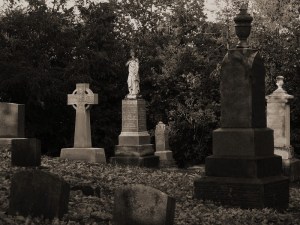
Last week, hackers in Great Falls, Montana infiltrated KRTV’s Emergency Alert System (EAS) and broadcasted a dire warning to viewers—the zombie apocalypse had begun. A pulsating noise followed by a voice drowned the audio to the regularly scheduled program. “Dead bodies are rising from their graves.” A blue bar at the top of TV screens ran the names of counties and areas affected by the event.

The announcement continued: “Follow the messages onscreen that will be updated as information becomes available. Do not attempt to approach or apprehend these bodies as they are considered extremely dangerous.”

Local police reported viewers had called the station requesting information. What type of firearm can the citizens use against the roamers? Of course, the police took every call seriously even though folks had placed them in jest.

But has anyone ever asked if this scenario is actually possible? It’s all very well and fine that we know this whole thing was a hoax. Who in their right mind would take something like this and act on it is beyond me. However, several things stand out.

How did the hackers gain access to the EAS? Aren’t there security checks in place to prevent this kind of thing from happening? Who performs the yearly audit of the system? Shouldn’t someone have caught this vulnerability in deployment testing? If I were the affiliate station, I would certainly place a very concerned call to the FCC demanding a revamp of the system. Then again, I am Canadian, so my ramblings really don’t count.

More importantly, I’ll ask again, has anyone yet asked if a scenario such as this is possible?

My answer? No. A resounding no! Dead bodies rising from their graves makes for a cool horror flick but looking at it from the perspective of science can prove informative.

Shaughnessy Hospital Morgue

There’s this thing called Primary Flaccidity that occurs soon after death whereby every muscle in the body relaxes. Following this condition is Rigor Mortis, which takes place about three hours after death causing muscles in the body to stiffen. During this stiffening process, blood pools into larger veins discoloring the body giving it a pale look. This is called Livor Mortis or what embalmers call Postmortem Stain, for the bruise-like appearance of where the blood settles. The sequence by which the body stiffens tends to differ due to the variance with lactic acid levels in the muscles and glycogen levels in the different types of muscle fibers. Suffice it to say the process may begin with eyelids, neck and jaw. During the course of Rigor Mortis, the body cools in another process called Algor Mortis.

Within twenty-four to forty-eight hours, the body’s muscles relax again in Secondary Flaccidity. Within a week, the abdomen swells with gas produced by bacteria in the body. Skin blisters appear. Within two weeks, abdomen tightens and swells further. Within three weeks, organs and cavities burst. Nails fall off. Within a month, skin liquefies making the body unrecognizable.

It’s pretty morbid but fascinating nonetheless.

Anyway, getting back to the scenario of dead bodies rising from their graves in a maelstrom invasion of sorts—impossible. That is, impossible if the bodies hadn’t gone through decomposition. It would mean every body rising in every grave had to have died within minutes of each other and rise just before Rigor Mortis stiffened the muscles, Livor Mortis pooled the blood, Algor Mortis cooled the flesh, and Secondary Flaccidity prepped the abdomen for exploding organs.

Doesn’t make sense to me. If the reports from Montana were true, they’d of had skeletons roaming the streets and not bodies.

What does make sense, though, is an invasion born of the living, much like the post Zombie Apocalypse: Ground Zero I’d written regarding the origins of such an event.

What do you think? Is a Zombie Apocalypse possible from bodies rising from the graves? Where does science fit in all this?