Posted in Monday Mayhem

Zombies & Aliens?

It’s all about a contagion nowadays. Zombies sprout from a fatal plague released on an unsuspecting nation bent on its own destruction. A cough, a sneeze, a scratch and everyone runs for cover. But what if the zombie virus doesn’t come from a genetic mutation of the common cold?

Cloverfield
Cloverfield

Just sayin’.

Monday Mayhem has featured many end-of-days scenarios.What if the plague everyone’s waiting for is not the catalyst that jumpstarts the zombie apocalypse? What if it’s something else?

Legend has it that Haitian voodoo doctors had the ability to raise the dead. In some cases, raise the dead and make the undead their slaves. Cases exist indicating supposed resurrections took place soon after death, which in turn caused residents to question the veracity of such claims. It wasn’t until sometime had passed that authorities had discovered witch doctors had used psychoactive drugs to render victims unconscious to the point where they appeared dead. Village medical doctors could not detect a pulse therefore their declaration on the death certificate rang true. However, soon after burial, the witch doctors would order exhumations so as to use the dead for working on sugar plantations.

A hundred years ago, everyone thought the zombie apocalypse would happen from voodoo doctors gone wild, hypnotizing a whole generation of folks into believing they would become the undead. My, how times have changed.
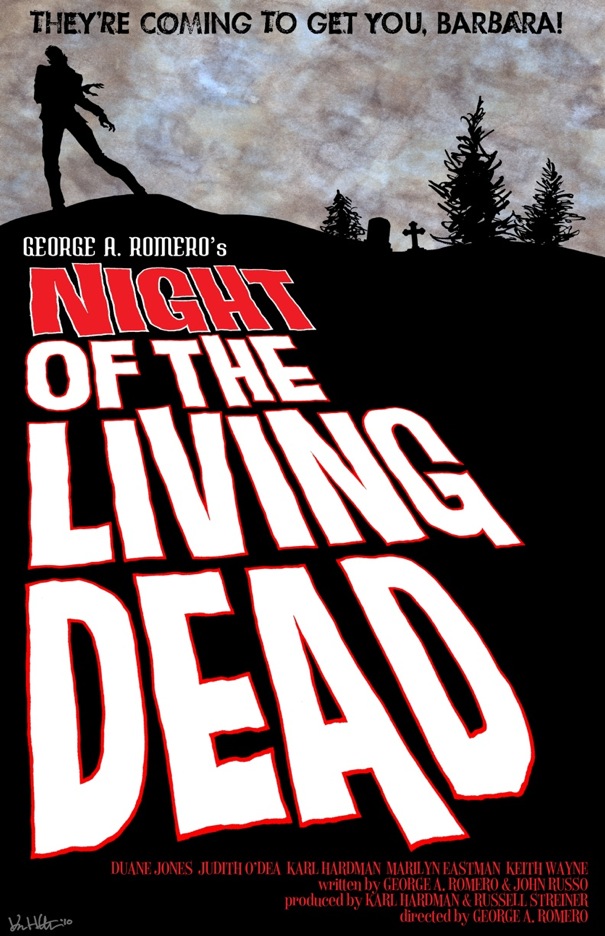
Night of the Living Dead

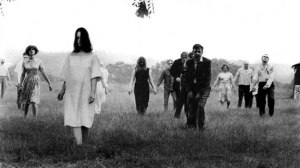
Then came George A. Romero’s Night of the Living Dead, the director’s 1968 anthem to the zombie apocalypse. The premise is an easy one. A radioactive space probe from Venus explodes in Earth’s atmosphere rendering those caught in the debris, zombies. No plague here. The zombies go on a rampage to secure food for which they can feast. Unfortunately, the only food they have in mind is ingesting human. Romero’s film singlehandedly created the zombie genre we know today. However, the one factor separating Romero’s zombie apocalypse with today’s undead story makers is in Romero’s zombie origins—they came from space.

Seems quite a great deal comes from space nowadays. Transformers, Independence Day aliens, Predator, E.T., Cloverfield aliens, Close Encounters of the Third Kind aliens, Invasion of the Body Snatcher aliens, Super 8 aliens.

See a pattern here?

Who’s to say zombies will not come from space?

Just sayin’.

RANGER MARTIN AND THE ZOMBIE APOCALYPSE, now on sale.

Do you still believe a plague will cause the zombie apocalypse?

Posted in Monday Mayhem

A Zombie Party

Growing up in one of the toughest neighborhoods in Toronto, my parents provided me a normal childhood by rearing me on a steady diet of cartoons, sitcoms and movies. TV introduced me to a world of characters I would have otherwise not known. Some of those characters possessed the skill to frighten me in ways that would prevent me from having a good night’s sleep. Dracula, Frankenstein, the werewolf, and to some extent, the mummy creeped me out. Zombies never did anything for me.

28 Days Later
28 Days Later

Shocking, isn’t it? It’s Monday Mayhem. Would you expect anything less?

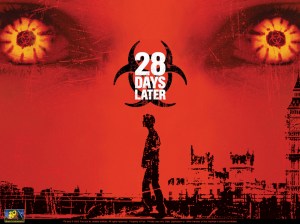
I mentioned this once before in another post that as a kid I considered zombies cartoonish, pasty, disfigured anomalies I didn’t take seriously until I saw the movie 28 Days Later. That’s when I knew my life had changed and couldn’t look at zombies the same way again.

Since then, I have a staple of movies I recommend to everyone interested in understanding zombies better. By no means are these the best zombie films, but they are defining works for the genre.

If you’ve read me long enough, you’ll know how much I enjoy George A. Romero’s undead compendium—The Night of the Living Dead, Dawn of the Dead, and Land of the Dead. Produced over the course of thirty years, these films set the rules for subsequent zombie behavior. Although some may consider these B movies, every year these titles have withstood the test of time by attracting new audiences with their original concepts and stories.

I’ve learned from these movies The Three Commandments of the undead:

I—The Dead Have Come Back to Life
II—The Undead Crave Human Flesh
III—The Undead Will Die with a Blow to the Brain

As noted, 28 Days Later is the perfect introduction for new film students feeling the need to want to appreciate the zombie genre. The movie contains ideas some viewers may find interesting. For instance, the work presents a solid case regarding a zombie apocalypse fashioned after a virus running rampant among the population. Also dominant in this film are fast zombies, something explored fully in World War Z.

Zombieland Rule #8
Zombieland Rule #8

These last two movies are my favorites. Without these, folks would take zombies much too seriously. I’m talking about Zombieland and Shaun of the Dead. Both films have their quirks. Both films are equally hilarious. The more useful of the two, Zombieland details a set of rules zombie apocalypse survivors can utilize to remain alive. Instructions such as “beware of bathrooms” and “cardio” made it into the Top 10. Shaun of the Dead makes an impression by the amount of gags it pulls. In one scene, the boys throw vinyl records on the oncoming undead all the while arguing as to which records to throw, always having a favorite they’d rather save as a keepsake.

Indeed, I could mention many other movies, but these ones provide a future zombie film enthusiast something to think about when perusing online for a title to watch on a cold Friday night. Who knows, maybe they’ll even find the Resident Evil franchise to whet their appetite (pun fully intended).

RANGER MARTIN AND THE ZOMBIE APOCALYPSE, now on sale.

What movies would you recommend your friends to watch that would act as a primer for learning about zombies?

Posted in Monday Mayhem

Zombie Evolution

George A. Romero, the father of modern zombie flicks, said in a recent interview with Daily Dead that zombies are advancing at a rapid pace—in his words, “advancing even a little further.” As part of my Monday Mayhem series, let’s have a look just how advanced zombies have become from their docile, sloth-like beginnings.

Night of the Living Dead

When Night of the Living Dead made its debut in 1968, the campy feel to the scenes made this film a Horror lover’s delight. What audiences didn’t know was the movie would go on to become an anchor to which other movies in the zombie genre would aspire. For years after its release, zombies had the intellect of vegetables and lurched to wherever they needed to go. They didn’t have reasoning skills. They lacked any sense of intelligence. If they wanted something, they’d hunt for it until they found it. Zombies back then were somewhat silly.

This is where Romero’s 1978 Dawn of the Dead exceeds. All of a sudden, zombies became focused, one-track-minded, machines. They wanted flesh and would do anything to get to it. Their strength to combat those who stood in their way became paramount. Their greatest asset became in attacking in numbers. One zombie will not do it. But maybe many would. And that’s just what happened in this film.

Then in 2005, Romero made a point with Land of the Dead that zombies were here to stay. The undead became intelligent. A character by the name of Big Daddy took over the screen teaching other zombies how to fight the human resistance, taking arms, and pushing forward to destroy those who interfered with the zombie plan to annihilate humans from the face of the earth. (Incidentally, filming took place in a prominent location in Toronto of which I am very well familiar.)

World War Z Horde
World War Z Horde

At the same time, in 2002, director Paul W.S. Anderson presented a version of zombie others couldn’t soon dismiss. In Resident Evil, the idea of a fast zombie took hold, the impact of which wouldn’t be realized for a decade or more. When 28 Days Later appeared later that year, the fast zombie had begun to proliferate modern media, and studios looked to screenwriters for original ideas regarding the concept.

But it wasn’t until 2013 when World War Z’s fast zombies became the norm. The film depicted the undead as stampeding Velociraptors that had the ability to hop from walls without consequence. Gone are the days when zombies lurched from area to area in a slow drag that would aid in the salvation of mankind. Instead, these zombies had the ability to launch from their stationary positions to a determined path simply by allowing a smell or a sound to guide them.

What will 2014 hold for the zombie evolution? Will there be a film so different, so astounding that it will rock the zombie apocalypse foundations from its axis?

RANGER MARTIN AND THE ZOMBIE APOCALYPSE, now on sale.

What do you think will come next for the zombie genre?

Posted in Monday Mayhem

Zombie Movies II

In April, I featured a post for Monday Mayhem called Zombie Movies. Many of my readers enjoyed the films I had chosen, adding their own suggestions to the list of works I could highlight for a future post. Well, this is the future post. As part of this list, I’m including two new entries to the zombie genre. One film had released late last year to positive reviews and the other is still in theaters. Don’t worry I won’t give away any spoilers.

World War Z
World War Z

World War Z—For us zombie lovers, this movie, by far, is the movie of the year. Still playing in theaters, still making money and still thrilling audiences over, the story is the brainchild of Max Brooks, son to funnyman Mel Brooks who directed Young Frankenstein, another movie about a dead guy coming back to life, but in a more affable state (yes—that was one long sentence). Although the movie is nothing like the book, the film features something other zombie movies have only hinted, fast zombies. I’m talking about freaks of nature you’d dare not mess with. The movie itself is an instant classic benefiting from multiple viewings. There’s just too much to absorb in a single viewing.

28 Weeks Later
28 Weeks Later

28 Weeks Later—The Rage virus that ravaged London took its toll in 28 Days Later. Six months later, the U.S. army gets involved in the quarantine of the city and the rebuilding process. Little does anyone know a carrier of the virus enters the city limits and aids in the final decimation of the population. Believe me, if you’ve seen the first movie, this second one is much of the same. The enjoyment of this film is watching how good intentions cause the greatest misery.

Dawn of the Dead
Dawn of the Dead

Dawn of the Dead—In this original George A. Romero 1978 vehicle, the zombies had less intelligence and moved slower. One could duck and crawl to safety without worrying the zombies will catch their victim. The big thing about these zombies is their tenacity. Once one of them finds a human, you’d best be sure a crowd would soon follow. It’s also a joy seeing how the survivors manage to handle their situation in a closed and confined area, a mall. The funniest segment, though, has to be the precious scene where the survivors hunt zombies to the rhythm of circus music (merry-go-round music).

Night of the Living Dead

Night of the Living Dead—First of all, this movie is incredibly low budget. Mind you, this is not a bad thing. For the Sixties, there were many big budget bombs, and when this movie hit the scene, no one knew what to make of it. The general premise has the recently deceased rise due to satellite radiation. The dead attack a barn, rather, the people in the barn, as they attempt to get at the victims’ brains. Another George A. Romero film, which some consider started the zombie tales, myths and legends of old. Forty-five years later, no true zombie fan should miss this zombie classic.

Return of the Living Dead

Return of the Living Dead—The movie’s catch phrase should tell you the whole story, “They’re back from the grave and ready to party!” This is a movie for a Friday night with lots of friends, snacks and conversation. It’s worth watching for its B-movie entertainment value. This time, the zombies rise from a deadly gas accidentally released by a couple of bumbling medical supply warehouse employees.

Warm Bodies
Warm Bodies

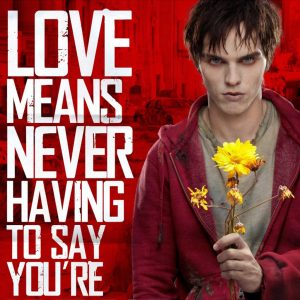
Warm Bodies—Not wanting to spoil it for anyone who hasn’t seen it, this is the zombie genre’s answer to Twilight. Kind of like Romeo & Juliet, teenagers in love, having nothing but their whole life ahead of them. Can it be any sweeter? It could, if it weren’t for all the zombies getting in the way.

RANGER MARTIN AND THE ZOMBIE APOCALYPSE, on sale October 22.

Can you think of other zombie movies I could have included in the list?

Posted in Monday Mayhem

Zombies: The New Vampires

It wasn’t long ago when audiences packed theaters for vampire-themed movies. Much of that popularity came from young readers devouring books like Twilight. How quickly trends change. With the new release of the film World War Z this summer, zombies will all but secure the top spot as the new vampires.

Don't Open, Dead Inside
Don’t Open, Dead Inside

How did this happen? For this edition of Monday Mayhem, my series devoted to all things crazy and insane, I’d like to explore the rise of the zombie from a knuckle-dragging goon to a sophisticated eating machine.

Disclaimer: If anything my regular readers know about me is, I’m a zombie purist. I’m a huge fan of George A. Romero, the father of modern zombie behavioral science. Have that in mind when reading this post, since I’ll probably offer my opinion on more than one occasion—or not.

At one time, vampires ruled the earth. Bookstore shelves couldn’t keep up with the insatiable demand to carry the latest and greatest vampire series. Every Halloween the most popular costumes had to have fangs and pale white makeup kits. Theaters featured vampires making dinner meat out of humans, vampires killing werewolves, and vampires falling in love. Topics on radio shows included: Whenever you hear thunder, do you wonder if vampires are playing baseball?

What happened to the vampire?

by Baby Doll
Zombie at the Door

Zombies are what happened to vampires. Just like their genetic makeup, zombies crept into mainstream popularity and are now eating away at every form of media. The movie Warm Bodies is the latest entry to the genre, which film critics loved as the zombie equivalent to Twilight. The steady growth of zombie fandom hasn’t relented one bit either. Shows like The Walking Dead and In the Flesh have captured the imagination of viewers everywhere. Sites devoted to the undead have sprung up throughout the world. Commercials have even gotten in on the act. Zombies apparently love BMW, Ford and Doritos.

How did this all happen?

In the 1920s, H. P. Lovecraft wrote a short story called Herbert West—Reanimator. Inspired by Frankenstein, Lovecraft’s mad doctor believed he could bring life back from the dead, which he did. The caveat being the creatures reanimated came back as starved cannibals, killing and eating everyone in sight. Sounds familiar, huh?

In 1954, Richard Matheson wrote I Am Legend. Although devoted to vampirism, the common story elements with modern day zombies are evident. A virus infects humans who then infect other humans with their bites. In the 2007 movie by the same name, Will Smith fights dark seekers, which blurs the lines between vampires and zombies even further. Although never spoken of as vampires, if one were to view dark seekers simply by their behavior, one would think they are zombies (feed off humans, affected by a virus, etc.).

However, it wasn’t until 1968 when director George A. Romero released The Night of the Living Dead that zombies became what they are today—single-minded eating machines. These are the same zombies featured in the show The Walking Dead (born from the dead, crave human flesh and will die with a blow to the head—as I’d written in my post The Three Commandments).

This gradual escalation of zombie popularity has yet to abate. Once we see a full-scale acceptance of the zombie genre, that’s when a true zombie apocalypse will have taken place.

Have we seen the last of vampires? Do you think someone will write about a family of zombies?

Posted in Monday Mayhem

The Three Commandments

In recent times, moviegoers have come to realize there are no absolutes when dealing with the horror genre. Ghosts can eat food (Pirates of the Caribbean), werewolves can change at will (Underworld), and vampires can sparkle when exposed to sunlight (Twilight). However, all bets are off when we talk about zombies. Zombies live in a world of absolutes.

Zombie Hand
Zombie Hand

As a primer to my Monday Mayhem series, let’s examine The Three Commandments of the undead. Established by director George A. Romero in the 1968 movie Night of the Living Dead and solidified in his 1978 film Dawn of the Dead, these three laws are what make the zombie genre unique. Without them, zombies wouldn’t exist in their present form.

I—The Dead Have Come Back to Life

A zombie isn’t a zombie unless it comes back from the dead. Much like vampires, zombies were once dead. Hence the name: undead. Through a biochemical change, voodoo or some other form of reanimation, the dead rises. This is the crux of zombiehood. Without it, zombies simply are not zombies.

What about a virus? In modern storytelling, a virus is the usual suspect in the blame-game for many undead creations. Typically, the virus runs through a population, changing them to become zombies. In strict technical terms, these creatures may not qualify as true zombies if the victims do not initially die. However, I argue if a virus has an element of death associate with it (biological or intellectual), then of course the resultant creature is none other than a zombie.

The key here is to note a physical transformation from death to life.

II—The Undead Crave Human Flesh

Every biological species requires sustenance to maintain health. Zombies do not. Zombies eat because it’s in their nature to hunger after human meat. It’s a compulsion. They cannot turn off the desire to slay a human and feed off the body. They just can’t. They are like the sharks of the underworld. They yearn, hunt, kill and eat. That’s it. They don’t stop. From one body to another, they’ll consume a whole town without regard. They are never satiated.

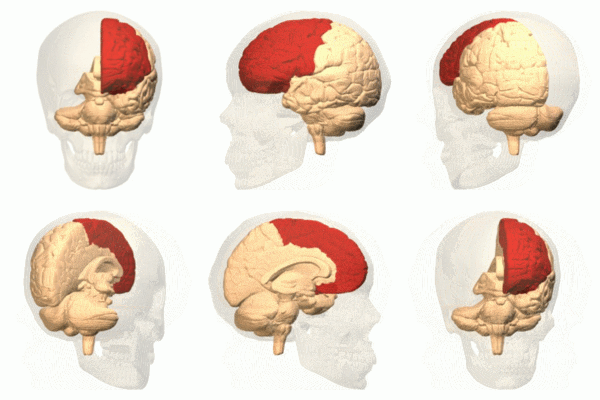
The Frontal Lobe
The Frontal Lobe

III—The Undead Will Die with a Blow to the Brain

The only thing that will stop a zombie is the destruction of its brain. A hunter of the undead can use various methods to attain this result. The most common is a bullet to the head. A knife through the temple will also do a fine job of ridding the earth of the vermin species. As would any of these other methods: An ice pick through the eye socket, multiple blows from a baseball bat, a sharp stick through its mouth thereby severing its spinal cord, a screwdriver to the back of the skull, a meat cleaver aimed directly at the frontal lobe, etc. The possibilities are endless. The purpose is to render the creature dead by inflicting the maximum amount of trauma to its brain. Once complete, the zombie will no longer pose a threat to any other humans.

Have you ever heard of The Three Commandments? What are your thoughts about zombiehood?

Posted in Women Who Wow Wednesday

Alice

The Hive. A secret research facility buried deep within the bowels of the earth. Red Queen. A supercomputer designed to maintain environmental control over The Hive. Alice. A wandering amnesiac. This is Women Who Wow Wednesday.

Resident Evil's Alice
Resident Evil’s Alice

There’s only one other badass chick who could even come close to Alice, and that’s Beatrix Kiddo of Quentin Tarantino‘s Kill Bill movies. Wait a minute. Correction. Hit-Girl definitely is in the same league as Alice, zombie killer extraordinaire.

She once played Leeloo in the 1997 movie The Fifth Element. However when Milla Jovovich took on the role of Alice in the Resident Evil franchise, she guaranteed her place in film history as the go-to character for zombie eradication.

Originally connected to director/producer George A. Romero (Night of the Living Dead, and Dawn of the Dead), Resident Evil blew away the box office in March 2002 taking in $102 Million worldwide. Not bad for a $33 Million budget. Based on the 1996 video game, the film spawned four sequels, a CG movie, countless other video games, and a novelization called Resident Evil: The Umbrella Conspiracy.

Besides dancers hired to play zombies and dogs that couldn’t keep their makeup on (they kept eating their blood and meat costumes), what’s the big deal with Resident Evil?

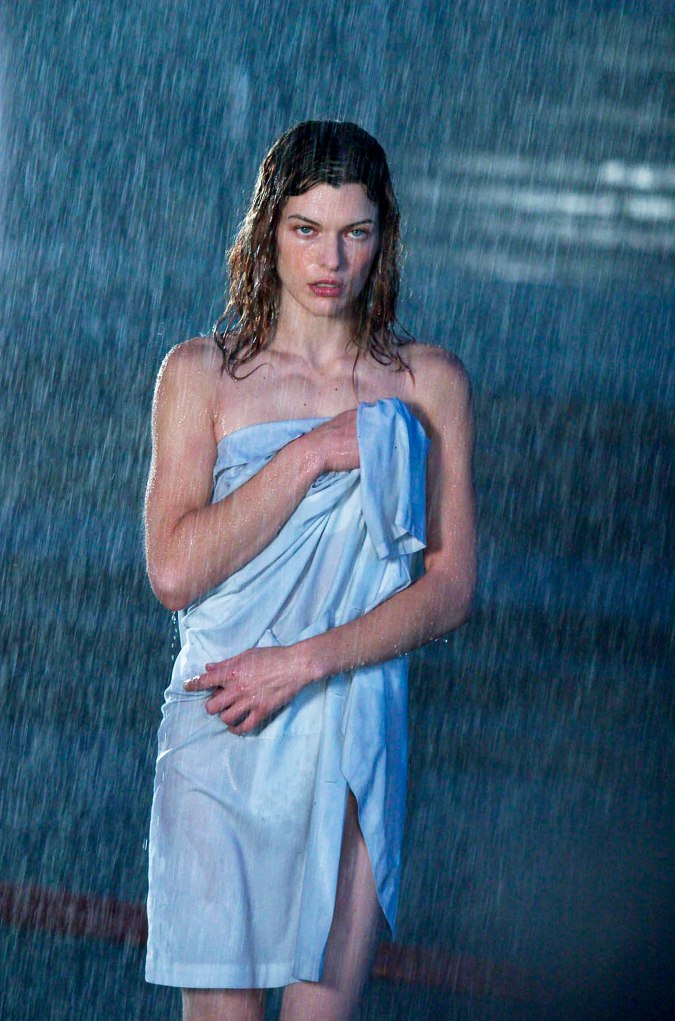
Milla Jovovich as Alice

Alice.

The audience is never quite sure what to make of her. She can pound a zombie to a mush of goo but also can slink across a floor in her most vulnerable, naked state. Proficient in firearms and hand-to-hand combat, Alice’s greatest strength is not her physical skill sets, though she may take on a hoard of undead single handedly, but her penchant for keeping her team safe. The very team sent to destroy Red Queen, The Hive’s supercomputer.

As the film and the series progresses, it becomes obvious Alice is not like other females. She possesses a degree of cunning that always matches her sad countenance. Her eyes give away her heart’s loneliness, even in the course of arms flaying, bullets flying, knives wounding, and heads rolling. She is superhuman. Why? How did it happen? What made her that way? Who gave her that power?

The key with Alice is the welfare of others. No matter how bad things get, zombies could crash through a door, smash through a window, tear apart walls and attack from all sides, Alice focuses on one thing and one thing only—how can she help the others. Nothing else distracts this vicious vixen of voracious vindication.

Others first. Her last.

There’s almost an element of religion with Alice. It’s as if she knows the golden rule: Do unto others as you would have others do unto you.

Have you seen Resident Evil? What do you think of Alice? Although not called zombies in the film, what do you think of the creatures?