Posted in Monday Mayhem

A Zombie Primer

I’ve always wanted to write a zombie Q&A for Monday Mayhem. Given some readers visit my site via search engines, I thought I’d provide answers to the most popular questions. Of course these are my opinions and I wouldn’t want to give the impression I know all there is to know about the subject. So think of me answering these questions flying by the seat of my pants.
Zombie banner
Zombie banner

What is the definition of a zombie?

In its purest form, a zombie is a soulless human either brought back to life by supernatural or biological means, or changed by a foreign agent. It is not sentient, thus it lacks the ability to question one’s own existence.

How does one become a zombie?

There are two schools of thought: (1) a human dies, and comes back from the dead. This can happen by voodoo, witchcraft or science. (2) A virus infects a human rendering them intellectually dead but physically alive.

How does one kill a zombie?

The most popular belief is to destroy the brain. Methods to achieve this result are as follows: shooting, stabbing, drilling, traumatic impact, etc. Decapitation may seem like a workable solution, however, in all likelihood it will lead to a bodiless zombie. When unsure, a sharp object to the brain will do the trick.
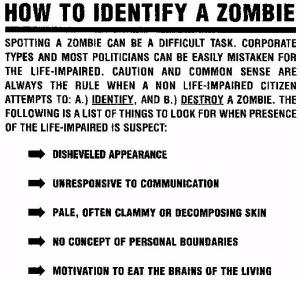
How to Identify a Zombie

Why do zombies crave human flesh?

There is no real answer. Some sources (legend, history, and Hollywood) may attribute zombie health to human flesh eating. If this were the case then it would necessitate zombies to require drink, sleep and other means by which to maintain proper balance of bodily functions normally attributed to humans. The closest answer is zombies eat human flesh because it’s in their nature, much like sharks (see my post The Three Commandments for a more elaborate answer).

Are there different types of zombies?

Yes. There are humans who were once dead, have risen from the dead, and are now alive. These are classic zombies. Then there are those humans who have changed into zombies due to the ingestion of a virulent agent.

Why do zombies hunt in packs?

Not all zombies hunt in packs. There will always be stragglers. The majority do though because of how the zombie apocalypse may have affected a particular area. If huge swaths of people become zombified, the natural tendency is for survivors to encounter them in packs. This will happen in countries where cities are more densely populated.

What is the zombie apocalypse?

The zombie apocalypse is a fictional scenario where zombies rise in an attempt to overthrow humans as the dominate species.

Do zombies take restroom breaks?

Most fictional accounts of zombies indicate an awful stench emanates from their body. It is not know what this smell is. Therefore, it would be difficult to assume that zombies practice proper hygiene in regards to their elimination habits.

Do you have any questions I may have missed? How about opinions?

Posted in Monday Mayhem

Humans vs. Zombies

The zombies are here. They have taken over college campuses worldwide. They will not surrender until every remaining human joins their cause. They are armed. And their weapons reflect their war—Nerf guns.

Humans vs. Zombies
Humans vs. Zombies

For my Monday Mayhem series last week, I wrote about The Zombie Run event taking place throughout cities in the United States. Proceeds of which go to Active Heroes, a charity that aids veterans, active duty military, and families. I thought I’d compliment that post with this one about the rage sweeping college campuses everywhere.

The game goes by the name of Humans vs. Zombies. Students describe it as the most elaborate game of tag anyone’s ever played. Awesome, as some have said.

This is how it works: two Original Zombies go up against about 150 humans. Armed with marshmallows, balled-up socks, and Nerf guns, the humans try to take out the zombies. Upon first inspection, a great disparity exists in numbers. However, that soon changes when one learns the zombies have a big advantage. After sitting out for fifteen minutes, the zombies can attack again. As this happens, the proportionate ratio of zombies to humans grows. At Montana State University, the zombies won the last event.

Nova Scotia students playing Humans vs. Zombies

Students enjoy the game as it presents opportunities to meet new people. It also promotes stress relief on campus.

The game comes with general rules of engagement (can change based on campus location).

  • Humans must wear armbands at all times.
  • Zombies must wear headbands at all times.
  • Original zombies are not required to wear headbands.
  • When humans tag zombies, zombies have to sit it out for fifteen minutes.
  • When zombies tag humans, zombies must collect their ID card. An hour later, the armband converts to a headband and the former human can now hunt humans. They are zombies.
  • Humans must stay on campus the entire period of the game.
  • Zombies cannot use shield to deflect darts.

And of course there are safety rules to adhere to.

  • No realistic looking weaponry. Blasters must be brightly colored and have blaze-orange tips.
  • Blasters may not be visible inside of academic buildings or jobs on campus.
  • Players may not use cars or play where there is traffic.
  • Foam darts must not hurt on impact.

The game seems like something I would have played in college. The Original Zombie idea makes it rather interesting as well, since Original Zombies do not have headbands and can easily take out unsuspecting humans by pretending to be human. The trick is to ask the question, “Are you a zombie?” Original Zombies cannot lie. But they can certainly stretch the truth. Perfect preparation for real world politics.

Have you heard of the game Humans vs. Zombies? Have you played it? If so, what did you like most about it?

Posted in Monday Mayhem

The Zombie Run

If you have a soft stomach, I suggest you leave—now. If not, I have news that may be beneficial to your health. For a while, I’ve followed an event so scary, so shocking, and so exciting; I couldn’t let it go much longer without including it in my Monday Mayhem series.

The Zombie Run
The Zombie Run

Some of you already know what I’m talking about based on the title for this post. Some of you have participated in the event and loved it. Some—have screamed in horror. What is it?

I’m talking about the annual Zombie Run. This year it kicked off for the first time in Philadelphia, PA. It will tour sixteen cities and promises to scare the crap out of anyone within the city limits. Okay, so maybe I’m using lots of hyperbole, but y’all get what I’m saying, right?

How does it work?

Actors dressed as zombies chase participants in a 5K (3.1 mile) run or sorts. The entire course will feature thematic elements of a zombie apocalypse (helicopters, flipped cars, fog machines, etc.). Boyhood buddies and race organizers Andrew Hudis and David Feinman came up with the idea when Hudis told Feinman he runs fastest when being chased. From there the idea took off (pun intended). Participants have a balloon pinned to their back and the object of the run is for the zombies to break the balloon.

The Zombie Run UK by Stevie Gill
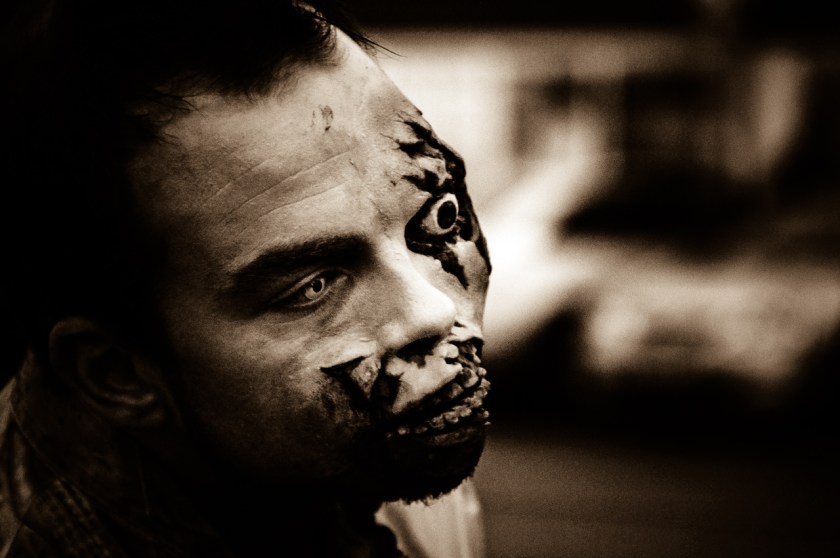
Bug Eyed Zombie (Zombie Run UK, Photo: Stevie Gill)
The Zombie Run UK by Stevie Gill
Mouth Full Zombie (Zombie Run UK, Photo: Stevie Gill)
The Zombie Run UK by Stevie Gill
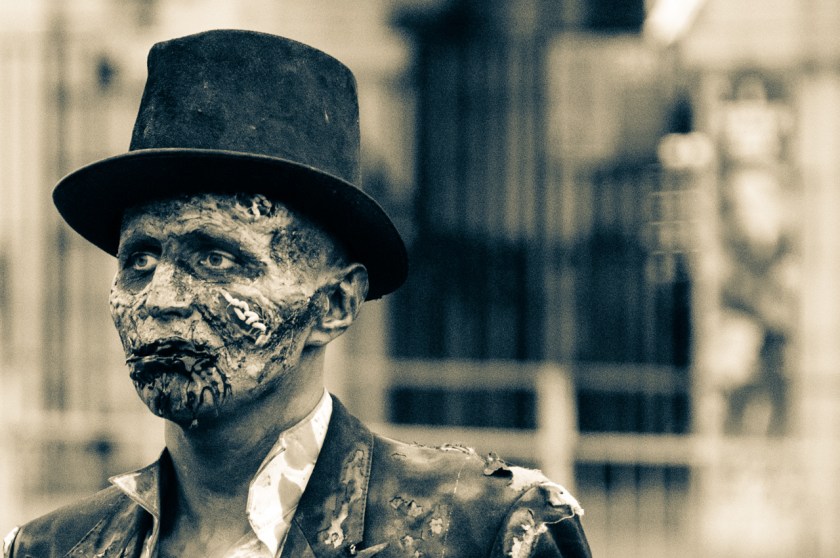
Tramp Zombie (Zombie Run UK, Photo: Stevie Gill)

Make no mistake. There will be running. There will be screaming. It’s a 5K haunted house run with onsite makeup artists. How cool is that? Once it’s over, it’s not over. The after party ensues to celebrate the event’s success.

The Zombie Run UK by Stevie Gill
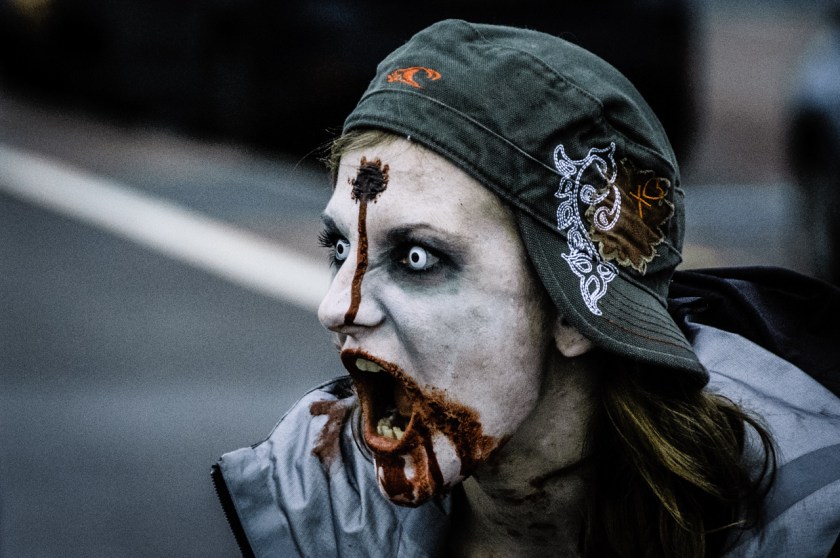
Blood Thirst Zombie (Zombie Run UK, Photo: Stevie Gill)
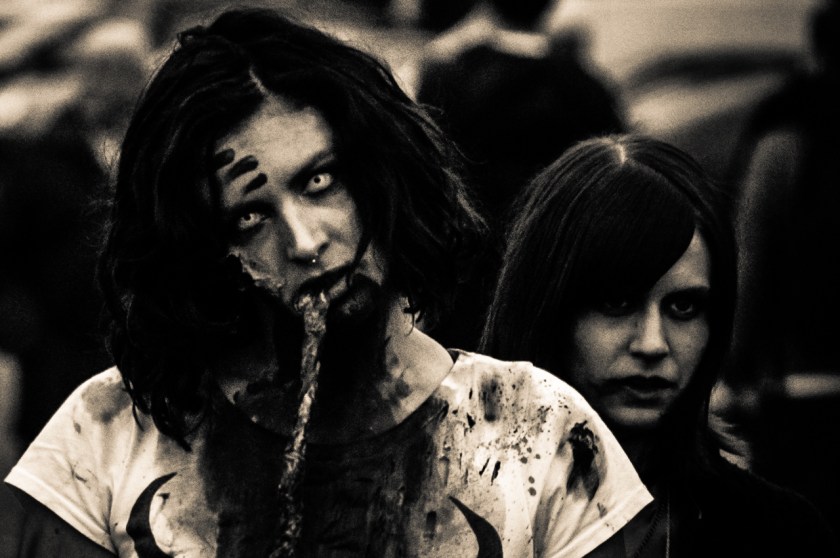
Rock Chick Zombie (Zombie Run UK, Photo: Stevie Gill)
The Zombie Run UK by Stevie Gill
80s Jogger Zombie (Zombie Run UK, Photo: Stevie Gill)
The Zombie Run UK by Stevie Gill
Donald Pleasence (Zombie Run UK, Photo: Stevie Gill)

The best part: proceeds will go to Active Heroes, a charity that aids veterans, active duty military, and families. A portion will also go to host city local charities. This is a fun and exciting way to give back to those who fight for freedom, and to the local community.

Here is a list of confirmed host cities participating in this year’s event:

  • Philadelphia Zombie Run – Sunday, April 7, 2013 at FDR Park. Start time is 8:00 AM.
  • Louisville Zombie Run – Sunday, April 21, 2013 at Iroquois Park. Start time is 12:30 PM.
  • Charlotte Zombie Run – Sunday, May 19, 2013 at Freedom Park. Start time is 12:30 PM.
  • Atlanta Zombie Run – Saturday, June 8th, 2013 at the Atlanta Motor Speedway. Start time is 10:00 AM.
  • New Orleans Zombie Run – Sunday, June 23, 2013 at New Orleans City Park. Start time is 9:00 AM.
  • St. Louis Zombie Run – Sunday, July 14, 2013 at Queeny Park. Start time is 11:00 AM.
  • Denver Zombie Run – Sunday, July 28, 2013 at City Park. Start time is 9:00 AM.
  • Seattle Zombie Run – Saturday, August 17, 2013 at Magnuson Park. Start time is 11:00 AM.
  • Indianapolis Zombie Run – Sunday, October 6th, 2013 at White River State Park. Start time is 11:00 AM.
  • Miami Zombie Run – Saturday, October 12, 2013 at Historic Virginia Key Beach Park. Start time is 6:00 PM.
  • Nashville Zombie Run – Sunday, September 29th, 2013 at Shelby Bottoms Park. Start time is 7:30 AM.

If you can’t make it to any one of these events, there are plenty others taking place throughout the world: Run For Your Lives, Zombie Escape, The Zombie Mud Run, and Zombie Run UK.

Thank you Stevie Gill for granting JackFlacco.com the use of your Zombie Run UK photography for this post.

Are you planning to participate in this year’s zombie runs? What do you find most exciting about the event?

Posted in Monday Mayhem

Zombies and the Law

An interesting article appeared in the Huffington Post recently. The gist of the story goes something like this: would zombies be legally responsible if they ate your brain? I laughed at the suggestion as well. Yet the question lends to some deep thought. Who would be responsible if a zombie ate your brain? Welcome to Monday Mayhem.

Zombie Justice
Zombie Justice

Lawyers Ryan Davidson and James Daily specialize in the legal ramifications of comic book hypothetical situations. In other words, these guys are cool. They take simple comic book scenarios and view them in the strictest legal sense. Their next endeavor is zombies. What zombies do, how they do it, responsibility, tort, etc., all that stuff. Featured in The New York Times, Marketplace, the ABA Journal and others, the site Law and the Multiverse have provided enlightening ideas on the zombie genre.

According to Davidson, a zombie apocalypse wouldn’t only be a mess for humanity, but also for the courts. The law views individuals as either fully alive or fully dead. There’s no in-betweens or undead. The argument attributing responsibility to zombies for property damage or crimes against humanity takes an even more complicated turn when introducing awareness to the equation.

Here’s what Davidson had to say:

“It depends on how the disease works. If zombies are effectively unconscious, then they would be incapable of performing voluntary actions and thus immune to criminal liability (or civil liability, for that matter). The zombies in the most recent I Am Legend movie appear to be fully conscious, if perhaps a bit aggressive, so they could potentially be found liable. But in most others, probably not.”

28 Days Later
28 Days Later

Then the question of rights comes to play. Would zombies have rights? He continues:

“If zombies are re-animated corpses, then no. The dead have no rights. But if zombies are living people infected with some kind of virus, like in 28 Days Later, they still have all the same rights they did before infection.”

Of course, if former zombies hire good lawyers, they can get off on an insanity plea. At least this is something the courts would have to take into consideration, should the defendants find their minds again and be fit to stand trial. Davidson was clear about this issue:

“If the crimes were committed while they were a zombie, and if the zombie condition causes legal insanity (basically defined in many states as not knowing what you are doing and not knowing that what you are doing is wrong), then they would have an insanity defense, even if they were later cured.”

He was quick to clarify those individuals suffering from mental illnesses today are not zombies.

To add to the discussion, the last portion of his interview delves into the “what if” scenario of capturing a zombie and placing it on trial for capital crimes and the like. Not only would said zombie be deemed unfit to stand trial, it would also have difficulties working with counsel. Not to mention the court would have an arduous task finding a jury of its peers.

Does bringing a zombie to trial seem feasible? What other problems may exist should a zombie find itself in court?

Posted in Monday Mayhem

Zombies: The New Vampires

It wasn’t long ago when audiences packed theaters for vampire-themed movies. Much of that popularity came from young readers devouring books like Twilight. How quickly trends change. With the new release of the film World War Z this summer, zombies will all but secure the top spot as the new vampires.

Don't Open, Dead Inside
Don’t Open, Dead Inside

How did this happen? For this edition of Monday Mayhem, my series devoted to all things crazy and insane, I’d like to explore the rise of the zombie from a knuckle-dragging goon to a sophisticated eating machine.

Disclaimer: If anything my regular readers know about me is, I’m a zombie purist. I’m a huge fan of George A. Romero, the father of modern zombie behavioral science. Have that in mind when reading this post, since I’ll probably offer my opinion on more than one occasion—or not.

At one time, vampires ruled the earth. Bookstore shelves couldn’t keep up with the insatiable demand to carry the latest and greatest vampire series. Every Halloween the most popular costumes had to have fangs and pale white makeup kits. Theaters featured vampires making dinner meat out of humans, vampires killing werewolves, and vampires falling in love. Topics on radio shows included: Whenever you hear thunder, do you wonder if vampires are playing baseball?

What happened to the vampire?

by Baby Doll
Zombie at the Door

Zombies are what happened to vampires. Just like their genetic makeup, zombies crept into mainstream popularity and are now eating away at every form of media. The movie Warm Bodies is the latest entry to the genre, which film critics loved as the zombie equivalent to Twilight. The steady growth of zombie fandom hasn’t relented one bit either. Shows like The Walking Dead and In the Flesh have captured the imagination of viewers everywhere. Sites devoted to the undead have sprung up throughout the world. Commercials have even gotten in on the act. Zombies apparently love BMW, Ford and Doritos.

How did this all happen?

In the 1920s, H. P. Lovecraft wrote a short story called Herbert West—Reanimator. Inspired by Frankenstein, Lovecraft’s mad doctor believed he could bring life back from the dead, which he did. The caveat being the creatures reanimated came back as starved cannibals, killing and eating everyone in sight. Sounds familiar, huh?

In 1954, Richard Matheson wrote I Am Legend. Although devoted to vampirism, the common story elements with modern day zombies are evident. A virus infects humans who then infect other humans with their bites. In the 2007 movie by the same name, Will Smith fights dark seekers, which blurs the lines between vampires and zombies even further. Although never spoken of as vampires, if one were to view dark seekers simply by their behavior, one would think they are zombies (feed off humans, affected by a virus, etc.).

However, it wasn’t until 1968 when director George A. Romero released The Night of the Living Dead that zombies became what they are today—single-minded eating machines. These are the same zombies featured in the show The Walking Dead (born from the dead, crave human flesh and will die with a blow to the head—as I’d written in my post The Three Commandments).

This gradual escalation of zombie popularity has yet to abate. Once we see a full-scale acceptance of the zombie genre, that’s when a true zombie apocalypse will have taken place.

Have we seen the last of vampires? Do you think someone will write about a family of zombies?

Posted in Monday Mayhem

The Three Commandments

In recent times, moviegoers have come to realize there are no absolutes when dealing with the horror genre. Ghosts can eat food (Pirates of the Caribbean), werewolves can change at will (Underworld), and vampires can sparkle when exposed to sunlight (Twilight). However, all bets are off when we talk about zombies. Zombies live in a world of absolutes.

Zombie Hand
Zombie Hand

As a primer to my Monday Mayhem series, let’s examine The Three Commandments of the undead. Established by director George A. Romero in the 1968 movie Night of the Living Dead and solidified in his 1978 film Dawn of the Dead, these three laws are what make the zombie genre unique. Without them, zombies wouldn’t exist in their present form.

I—The Dead Have Come Back to Life

A zombie isn’t a zombie unless it comes back from the dead. Much like vampires, zombies were once dead. Hence the name: undead. Through a biochemical change, voodoo or some other form of reanimation, the dead rises. This is the crux of zombiehood. Without it, zombies simply are not zombies.

What about a virus? In modern storytelling, a virus is the usual suspect in the blame-game for many undead creations. Typically, the virus runs through a population, changing them to become zombies. In strict technical terms, these creatures may not qualify as true zombies if the victims do not initially die. However, I argue if a virus has an element of death associate with it (biological or intellectual), then of course the resultant creature is none other than a zombie.

The key here is to note a physical transformation from death to life.

II—The Undead Crave Human Flesh

Every biological species requires sustenance to maintain health. Zombies do not. Zombies eat because it’s in their nature to hunger after human meat. It’s a compulsion. They cannot turn off the desire to slay a human and feed off the body. They just can’t. They are like the sharks of the underworld. They yearn, hunt, kill and eat. That’s it. They don’t stop. From one body to another, they’ll consume a whole town without regard. They are never satiated.

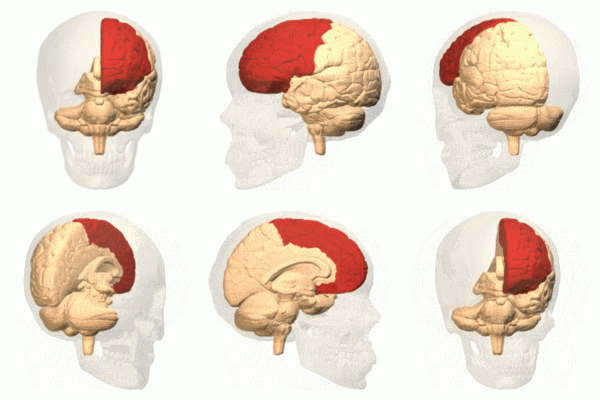
The Frontal Lobe
The Frontal Lobe

III—The Undead Will Die with a Blow to the Brain

The only thing that will stop a zombie is the destruction of its brain. A hunter of the undead can use various methods to attain this result. The most common is a bullet to the head. A knife through the temple will also do a fine job of ridding the earth of the vermin species. As would any of these other methods: An ice pick through the eye socket, multiple blows from a baseball bat, a sharp stick through its mouth thereby severing its spinal cord, a screwdriver to the back of the skull, a meat cleaver aimed directly at the frontal lobe, etc. The possibilities are endless. The purpose is to render the creature dead by inflicting the maximum amount of trauma to its brain. Once complete, the zombie will no longer pose a threat to any other humans.

Have you ever heard of The Three Commandments? What are your thoughts about zombiehood?

Posted in Monday Mayhem

Death’s Cure

Back in June last year, the Centers for Disease Control and Prevention (CDC) issued a statement denying knowledge of any virus that may reanimate dead tissue. O-kay. Further, they denied knowledge of any virus that would cause zombie-like symptoms. Right. This is my Monday Mayhem post and—I’m sorry, I have to keep from laughing. Give me a second. Ahem…

Nurse
Nurse

In an email to Huffington Post, David Daigle, the American health agency representative wrote: “CDC does not know of a virus or condition that would reanimate the dead (or one that would present zombie-like symptoms).”

Did you catch that? They’re saying they don’t know of a virus or condition that could reanimate dead tissue. They didn’t say it wasn’t possible. Seriously, what goes on behind those doors of the CDC?

You know, another fellow also believed in the reanimation of the dead. He was an obsessed scientist with the idea he could create life. He had an assistant who would provide him with the raw materials. He’d harvest the dead parts, sew them together and call the result human. But nothing could be further from the truth.

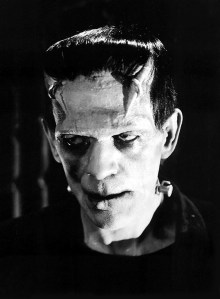
I’m talking of course of Dr. Victor Frankenstein and his inept assistant Igor. His ideas were commendable. Take the dead and breathe life back into them. Nothing short of a miracle, really. The results, however, told of a different story. A story of a scientist gone mad who wanted more than anything than to play God. His creature became one of the first known zombies in classical literature.

Frankenstein
Frankenstein

What makes Frankenstein’s story unique, or rather the lesson we can learn from the monster tale is “no good deed goes unpunished.” (I put it in quotes because it’s a famous saying. Didn’t know what else to do with it). In his zeal to create life out of nothingness, the good doctor didn’t stop to ask if he should. Thus, he created a walking corpse with barely enough intelligence to scour a frying pan.

The most horrific events to have happen to humanity have always been because of good intentions.

Getting back to what the CDC didn’t say. They didn’t say dead tissue reanimation isn’t possible. This leads one to conclude, albeit speculation based on evidentiary inference, that the CDC is studying dead matter reanimation. Yeah, this is the stuff that keeps me up at night.

What if it were true? What if we had the power to eradicate death? Then what?

Imagine a world where no one died. There would be no need for life insurance. Funeral homes would go out of business. All that cemetery land could go to house the living instead. We’d have more money for the economy, since mandatory retirement would disappear. We’d have less social programs. Terminal illnesses would be a thing of the past. And there would be no need for half-price Tuesdays for seniors.

Ah, can you hear the wheels of good intention churn?

If no one dies, how are we to feed everyone? When the cemetery land vanishes, where is everyone going to live? Will there be enough jobs to go around? And the big question: If we eliminate death does this mean we can eliminate aging? Because if we haven’t eliminated aging—we’ve got a major problem.

After about a hundred years, guaranteed we’ll have a real zombie apocalypse on our hands.

Comedic genius George Carlin once said:

“You know what I think they ought to do with those Miss America contests? I think they ought to keep making the losers come back until they win. I’ll tell you, that would get a little spooky after about thirty five years or so, huh?”

What do you think? Are we on the road to creating a Frankenstein monster? Should the CDC open its research facilities to third party monitoring?