Posted in My Journey

God’s Love Endures Forever

God loves us more than anything in the universe. He loves us more than the sun, more than the earth, more than anything. God’s love for us is so great such that he sacrificed his son Jesus so that he might save us from the penalty of sin. There is nothing God has withheld in order to give us life.

The prophet Isaiah spoke about God’s love this way:

Sing for joy, O heavens, and exult, O earth;
break forth, O mountains, into singing!
For the Lord has comforted his people
and will have compassion on his afflicted.

(Isaiah 49:13)

Later, in that same chapter Isaiah reveals one of the most significant prophecies recorded in the bible, “Behold, I have engraved you on the palms of my hands” (Isaiah 49:16). What is Isaiah talking about here? The context is all about Israel’s restoration, yet this one verse points to a time when God will give of himself for the salvation of those who believe. How is that possible?

When the Romans were holding Jesus’ hands steady on the cross, the engraver positioned his nails to write all our names on Jesus’ palms. Once our savior’s blood soaked the back of that cross, God’s love for us was complete. We all had a hand in the crucifixion, but God was the one who now had our names engraved on the palms of his hands.

If in our lives we reach a time when we feel abandoned, acquainted with sorrow, or rejected, there is no one else who felt that more than God’s son Jesus did when he hung on that cross. However, God’s love never failed Jesus, for he now sits at the right hand of the Father and is waiting for the day when he will come again. In the meantime, our names are safe with God, and he will not forget us when we pass from this life to the next, for his love endures forever.

Audio transcript:
Posted in My Journey

God’s Perfect Purpose

Jesus saves. God’s glorious work lives in Jesus’ perfect sacrifice for others, saving them from the penalty of their sins. Oh, what a wonderful, delightful and pleasing sacrifice that was to God the Father, creator of all things. He purposed his son’s destiny from the very beginning and gave to humanity the very desire to seek eternal life through him. Jesus is the only satisfying need we have that will render us complete.

The apostle Paul wrote about this to new believers who sought encouragement regarding their salvation:

“For God has not destined us for wrath, but to obtain salvation through our Lord Jesus Christ.” (1 Thessalonians 5:9)

Our faith as Christians in the one who is our savior, Jesus, is a testament to those who are seeking him but have not yet found him. For when we demonstrate our love for him, by keeping God’s word and testifying in his name, then truly we are preaching the gospel not only by works but also by faith. By believing that Jesus is the son of God will we rise to eternal life. The Book of Hebrews speaks about this faith this way, “But we are not of those who shrink back and are destroyed, but of those who have faith and preserve their souls” (Hebrews 10:39).

Therefore, whatever may be holding us back, whatever we may fear, let God’s purposed reason for our existence (Romans 8:28), proclaiming Jesus as his son, fill our hearts with joy and give us hope for the kingdom to come.

May God bless you all, and may peace dwell in your hearts and in your minds.

Audio transcript:

Posted in Bible Studies

Victory Over Sin

Believe that Jesus is the son of God and you will have salvation. He gave up his life for us while we were still sinners, so that his sacrifice would redeem us from the penalty of sin. But like a harlot, sin continually tempts us to love her in order that we may lose ourselves again to our fleshly desires.

King Solomon recognized sin’s wily ways. He wrote about them in the Book of Proverbs. In no greater context has he written about sin’s allure than that of adultery. This is what he says:

“For the lips of a forbidden woman drip honey, and her speech is smoother than oil, but in the end she is bitter as wormwood, sharp as a two-edged sword. Her feet go down to death; her steps follow the path to Sheol (a place of darkness).” (Proverbs 5:3-5)

Solomon is saying that sin looks beautiful on the outside. Her words are sweet to the ears and her reasoning behind doing what she does is smoother than the finest oil you can find. But Solomon is also saying that once you remove sin’s mask, underneath is an ugly bitterness that will corrupt the soul and will cut the spirit like a sharp, two-edged sword. The ultimate destiny for those who follow her steps will be the path that leads to death and darkness.

And if that stern warning was not convincing enough to keep away from her, Solomon gave sin, that whore, a voice:

“I have spread my couch with coverings, colored linens from Egyptian linen; I have perfumed my bed with myrrh, aloes, and cinnamon. Come, let us take our fill of love till morning; let us delight ourselves with love. For my husband is not at home; he has gone on a long journey; he took a bag of money with him; at full moon he will come home.” (Proverbs 7:16-19)

Sin’s deception is that she makes doing bad things look good. Even more so, if sin’s corruption can seduce the very elect, she will have accomplished what she had intended. This is why Jesus says in Matthew 7:21: “Not everyone who says to me, ‘Lord, Lord,’ will enter the kingdom of heaven, but the one who does the will of my Father who is in heaven.” He later describes the fate of the unrepentant:

“And then will I declare to them, ‘I never knew you; depart from me, you workers of lawlessness.’” (Matthew 7:23)

But the good news is that we have hope in Christ. We may fall and succumb to sin, but through Christ Jesus, our salvation is sure. The apostle Paul puts it this way in Philippians 4:13: “I can do all things through him who strengthens me.”

How wonderful to know that as Christians, we can look to Jesus as the source of our strength to overcome sin. What a delight it is to understand the fullness of God’s love through his mercy. And what a powerful destiny we have when finally sin and death will no longer exist.

All praise belongs to God Almighty in the highest, for he is good.

Posted in My Journey

God Does Not Abandon His Children

God is wonderful, amazing and patient with us. He knows what we need, when we need it and how. He surely keeps his promises to those who believe Christ is his son, but even more so, he will bless those who need it the most in their time of need.

I had something happen to me this week that I will tell you because I think it is important that everyone knows that when God acts, he acts swiftly, with purpose and with compassion. He definitely does not abandon his children, and this is one of those occasions I felt closer to God. I knew he was there, and he was looking out for me, taking away any insecurity I had during those moments I was feeling alone.

I had attended an event last week with a group of friends that I was looking forward to all year. We had the opportunity to share in food, fun and festivities. The event featured a potluck meal and a flexible seating arrangement, which I thought was great. It certainly promoted mingling. When we arrived, we dispersed, found the food, plated everything and proceeded to find a table. Only, when we did find an empty table, it could fit six and no more. There were seven of us. I was the last man standing, so to speak. So there I was, plate in hand filled with food without a seat. That sudden feeling of abandonment gripped my tummy, and for a while, it would not let go.

I decided to look for another place to sit, even though all the other tables seemed full. As I walked through the crowd, praying to God for restoration, I eventually did find a seat along the sidelines. Individual chairs were available and I took one. And once I had settled in, one of my friends who had taken a seat with the others, left the group, came and sat with me. God knew what I needed.

Now, I am relating this story to tell you that God does not abandon his people. At times we may feel alone and seemingly without support, but God knows above all else, how to resolve our situation in order to make it work for good. I am remembering the Apostle Peter’s sermon on the day of Pentecost when he said:

“He foresaw and spoke about the resurrection of the Christ, that he was not abandoned to Hades, nor did his flesh see corruption.” (Acts 2:31)

If God could raise his son Jesus from the dead, imagine what more he could do when we face something infinitely smaller in scale and we call on his name.

God has proven time and again his mercy for us Christians will never fail (Psalms 28:6). His love for us abounds (Romans 8:38-39) and his grace upon our lives goes beyond this lifetime and into the next (Ephesians 2:8). We have his spirit to encourage us (John 14:16), we have his joy to carry us through trials (James 1:2-3), and we have peace to settle us when weariness hits our bones (Psalms 4:8). He is the great redeemer (Psalms 78:35) and counselor (Isaiah 9:6). He will always be there for us.

God will never abandon us.

Posted in Bible Studies

Mark Your Bible

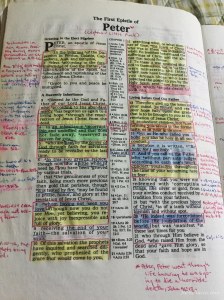
How do you mark your bible? A member of a church I once attended asked the minister this very question. The minister related this story during a sermon. His answer was surprising. He said, “How do you mark your bible? You mark your bible.”

As simplistic as it sounds, he was right. Sometimes we tend to overanalyze a rudimentary task and place a process around it when, in fact, all we need to do is do what comes naturally.

I say this because I am one of those people who needs structure and cannot start a project until I have all the pieces in place of where I want to go, what I want to do, and with whom I want to do it. Some tasks are meant to be organic, in that what we are doing at the moment is what should be done.

However, that is not to say that if you have a bible-marking system that works for you that you ought to abandon it. On the contrary, keep doing what you are doing. If it helps you learn the scriptures, there is no need to change something that is working. My advice is for those Christians who are wondering what to do when they buy their first bible and want to make notes in it but have no idea how to do that.

Again, I will say it: mark your bible.

How I used to mark my bible

How I marked my bible thirty years ago

I once had an elaborate marking system that enabled me to visually look at certain passages of the bible and know instantly what it was about. My color categories where:

  1. Blue—God
  2. Red—Angels and demons
  3. Brown—Humanity
  4. Orange—Civilization
  5. Purple—Israel
  6. Yellow—Church
  7. Green—Kingdom of God

In addition to coloring the verses, I also placed red-pen boxes around words I would want to define; and if something really stood out, I would underline phrases and words with a red pen. Of course, thinking I would need to differentiate what I learned at home with what I learned at church, I would carry around a blue pen and mark my bible that way during sermons.

For a long time, this system suited me. I appreciated it, and I enjoyed reading through marked sections again, gleaning tidbits of truth as I went along. I found, though, as the years went on, my understanding had grown and what I had believed twenty-five, thirty years ago, is not what I believe today. Several fundamentals are the same, but through diligent prayer and bible study, scriptures I had once marked as one thing suddenly had taken on a different meaning.

How I mark my bible today

Nowadays, I simply mark my bible. If a thought or a verse really stands out for me, affects me in a way that it has never affected me before, I mark it with whatever pen I have in my hand. I agree, it is a simplistic approach, but ultimately God through the Holy Spirit reveals what we need to remember when we read our bibles:

“But the Helper, the Holy Spirit, whom the Father will send in my name, he will teach you all things and bring to your remembrance all that I have said to you.” (John 14:25)

It is not how we mark our bibles, but what we gain from those passages we have marked.

Posted in Bible Studies

God’s Purpose

God is amazing. He really is. There are no other gods, because he is the only God; and as many times as we read that, he is even more amazing when bad things happen to Christians.

The book of Acts tells us about the early days of the church, from the time when Jesus ascended to heaven to when the apostle Paul arrived in Rome. Of the numerous accounts told, one in particular is an inspiration for Christians going through trials.

This week’s scripture is in the book of Philippians:

“And my God will supply every need of yours according to his riches in glory in Christ Jesus.” (Philippians 4:19)

The story of Stephen

In Acts, chapter 6, the apostles needed someone who would look after the widows in the church on their behalf in order that their preaching would not suffer neglect (Acts 6:1-2). They chose Stephen, a man full of faith and of the Holy Spirit. It was in those days that the church was growing larger, multiplying with believers (verses 3-7).

Now Stephen, full of grace and power, was performing great signs and wonders among the people. But there were certain men who rose up against him, disputing with him, wanting him to stop what he was doing. The more they went against him, though, the more they could not seem to overcome the wisdom and the Spirit with which Stephen was speaking. So they tried another tactic. They secretly instigated false witnesses to spew lies against him, saying he had spoken evil of the law and of the temple (verses 8-12).

The men eventually seized Stephen, brought him before the high priest and accused him of blasphemy (verses 12-14). And after a lengthy speech where Stephen spoke about Israel’s history, Moses’ part in the exodus, and how his accusers were resisting the Holy Spirit, the men brought him outside the city and stoned him (Acts 7).

Had God failed Stephen?

For a Christian to read this account, it may seem as if God had failed Stephen. One might ask, why would God allow this to happen? Did not Stephen believe God would have rescued him? Would God not have silenced his accusers and intervened on his behalf?

However, two very important things happened during Stephen’s death. First, before the stoning, Stephen saw the glory of God and Jesus standing at God’s right hand (Acts 7:55). Second, those taking part in the stoning were laying their clothes at the feet of a young man named Saul (verse 58). Both points are significant in that it shows God had not really abandoned Stephen during his time of trial; and not only God but also Jesus was there with him, reassuring him everything was going to be fine (verse 56). Even more so, Stephen did not die in vain. His death served to transform Saul from a man who persecuted the Christians, to the apostle Paul, a man preaching about Christ Jesus the son of God (Acts 22:20-21).

God has a purpose

Only God could do this. Only he could put meaning to a tragedy and make it work for good (Romans 8:28). As much as we try to understand why bad things happen to Christians, it all makes sense in the context of God using that tragedy to do good from a thousand perspectives (Psalms 147:5). We may gain a glimpse of a fraction of one of those perspectives, but God ultimately knows why certain things have to happen in certain ways (1 Corinthians 13:12).

What we have to do as Christians is trust him (Psalms 25:2). We may not receive the answer we desire, but we will certainly receive the answer we need (Philippians 4:19).

Posted in My Journey

You Are My Redeemer

Oh, Lord, creator of all things,
maker of all things great and small,
hear my prayer.

You are my redeemer;
you have given your son as a sacrifice for my sins.
My sins no longer blot me out of the book of life;
I am your servant; I am your son.

Lord, Father, you are my savior,
you are my king.
You are merciful and kind;
you have given me a tender heart.

When my enemies build ramparts against me,
you tear them down and turn them into dust.
I am safe with you,
for your bosom is my fortress and my strength. Selah.

All glory belongs to you, my God,
for your love is from everlasting to everlasting.
You are my redeemer;
you are my king.